
Heavy Metals in Baby Food & Spices: The Testing Importers Can't Skip
Lead, arsenic, cadmium, and mercury are the contaminants most likely to get a food shipment detained or recalled. For baby food and spice importers especially, heavy metals testing isn't optional it's the difference between a clean entry and a costly hold.
A widely reported recall of lead-contaminated cinnamon applesauce pouches poisoned hundreds of children and became a defining warning for the food import industry. The lesson for importers was blunt: a single contaminated spice ingredient can take down an entire product line. Because lead, arsenic, cadmium, and mercury occur naturally and are sometimes added for economic gain heavy metals testing has become a core safeguard for anyone importing baby food, spices, or the ingredients that go into them.
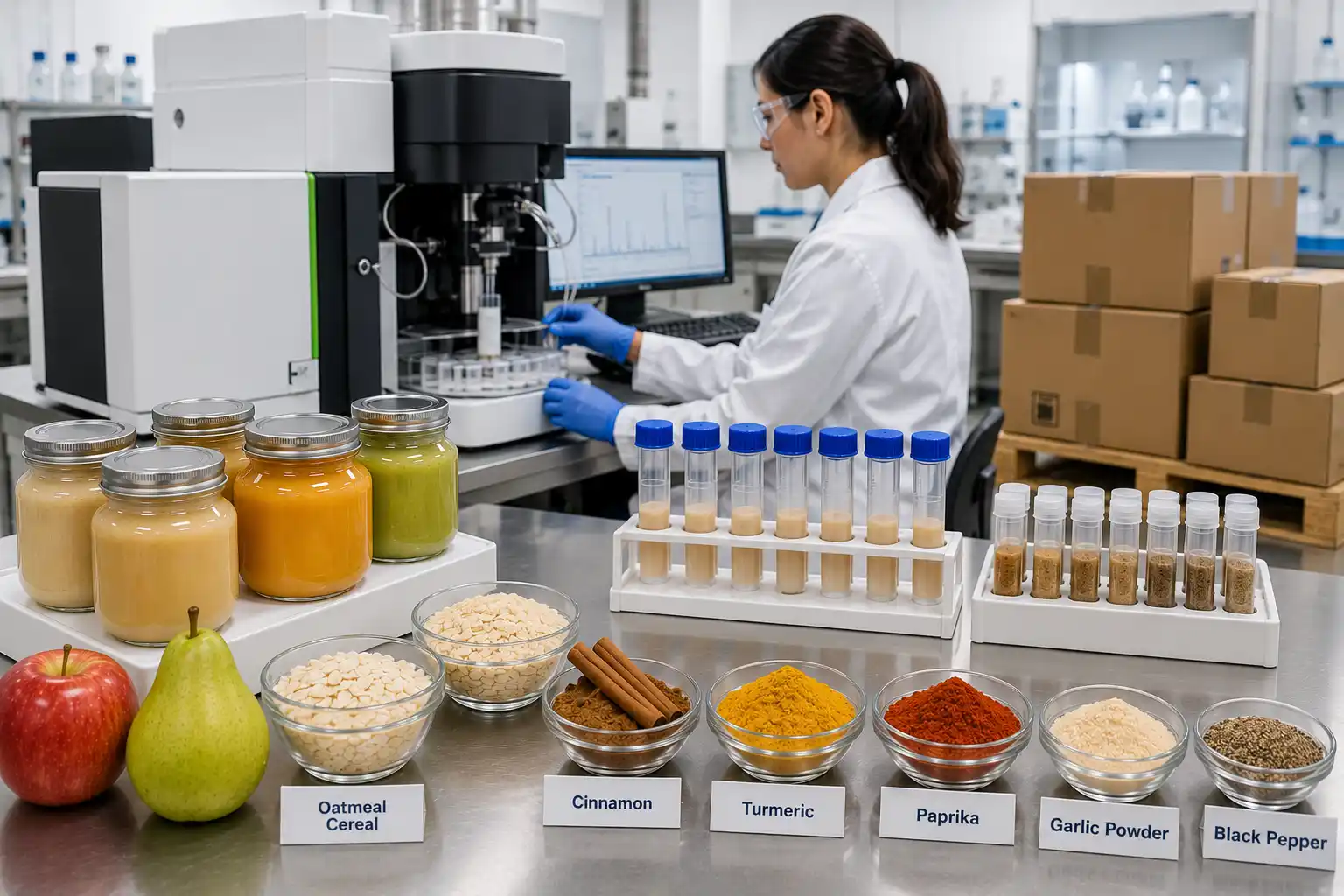
This guide is written for the people on the hook when a shipment is held: importers, distributors, and the brands that source baby food, purees, infant cereals, teas, botanicals, and spices from overseas. Throughout, we focus on U.S. FDA requirements. Use it to understand what regulators look for, where the risk concentrates, and how a testing program keeps your product moving through customs instead of sitting in a detention warehouse.
Step 1 — Why heavy metals are an importer's problem
Heavy metals enter food in two very different ways, and both matter to importers. The first is environmental: lead, arsenic, and cadmium occur naturally in soil and water, so crops like rice, root vegetables, cacao, and leafy botanicals absorb them as they grow. The second is adulteration: lead compounds are sometimes added to spices like turmeric, paprika, and cinnamon often to boost color or weight for economic gain which is exactly what drove the cinnamon-applesauce crisis.
For an importer, that combination is dangerous. You can buy from a reputable supplier, receive a clean-looking certificate of analysis, and still end up with a contaminated lot because the contamination entered the supply chain several steps upstream, or because the testing that produced the certificate wasn't rigorous enough to catch it. Independent laboratory screening at the point of import is your check on everything that happened before the product reached you.
Step 2 — The big four: lead, arsenic, cadmium & mercury
The FDA actively monitors four toxic elements above all others. Each behaves differently, concentrates in different foods, and carries its own health concern which is why a credible heavy metals testing panel covers all four rather than just one.
| Metal | Where it concentrates | Primary concern |
|---|---|---|
| Lead (Pb) | Spices, root vegetables, candy, cacao; intentional adulteration | Neurodevelopmental harm in children |
| Arsenic (As) | Rice and rice cereals, juices, some botanicals | Carcinogen; infant exposure |
| Cadmium (Cd) | Leafy greens, root vegetables, cacao, sunflower seeds | Kidney & bone toxicity |
| Mercury (Hg) | Fish and seafood; some herbal & ayurvedic products | Neurotoxin |
The FDA has acknowledged that these elements occur naturally and can't be eliminated entirely but it expects manufacturers and importers to analyze the hazard and take steps to keep levels as low as possible. That expectation is the foundation of the agency's Closer to Zero initiative.
Arsenic deserves a special mention because of rice. Rice takes up arsenic from soil and water more readily than most crops, so rice and rice-based products including infant rice cereal are a recurring concern. The FDA set an action level of 100 ppb of inorganic arsenic in infant rice cereal, and because it's the inorganic form that's toxic, the testing method has to distinguish inorganic arsenic from total arsenic. If you import rice, rice flour, or anything built on them, arsenic speciation belongs in your panel.
Step 3 — Baby food: the FDA's 2025 action levels
Baby food is the most scrutinized category in this space, and for good reason: infants and young children are the most vulnerable to lead's effects on brain development. As part of Closer to Zero, the FDA finalized its first action levels for lead in processed food intended for babies and young children under two the standard importers and manufacturers work to today.
| Baby food category | FDA lead action level | Status |
|---|---|---|
| Fruits, vegetables, mixtures, yogurts, meats | 10 ppb | Final guidance (2025) |
| Single-ingredient root vegetables | 20 ppb | Final guidance (2025) |
| Dry infant cereals | 20 ppb | Final guidance (2025) |
A few things importers should understand about these numbers. They are action levels, not brightline legal limits but the FDA can deem a food adulterated and take enforcement action against products that exceed them, so functionally you should treat them as targets to stay under. They cover lead only; the agency has signaled that draft action levels for arsenic and cadmium in baby food are coming as it works through its Closer to Zero timeline.
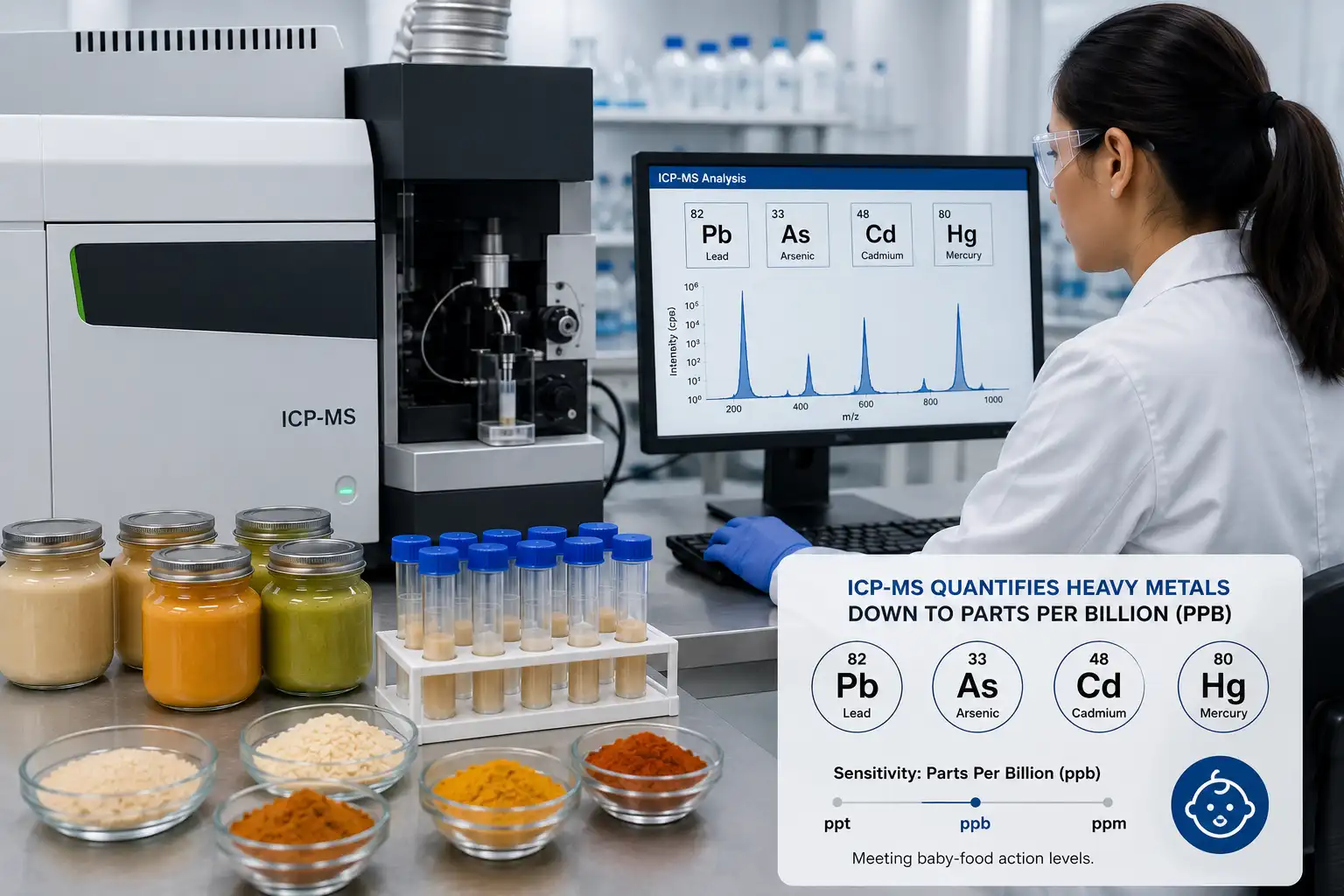
An action level of 10 parts per billion is extremely low it demands a lab with sensitive instrumentation (ICP-MS) and validated low-level methods. A general "heavy metals screen" with a high detection limit can report "none detected" and still miss a level that matters at the baby-food threshold. Confirm your lab can quantify down to the action level.
Step 4 — Spices: the hidden-risk category
Spices punch far above their weight as a contamination risk. They're consumed in small amounts, so they're easy to overlook yet they are repeatedly implicated in lead exposure, both from environmental uptake and from deliberate adulteration. Turmeric, in particular, has a documented history of lead chromate added to brighten its color, and more than a dozen turmeric products have been recalled over the years.
Independent testing has found that while most spices are fine, a meaningful fraction carry concerning levels of lead, arsenic, or cadmium and roughly two dozen spice companies from nearly a dozen countries are subject to FDA import alerts for lead contamination at any given time. The FDA runs a targeted Toxic Elements in Spices sampling program and maintains import controls on specific origins turmeric shipments, for example, face import scrutiny under Import Alert 54-15. For an importer, the takeaway is simple: spices and botanical ingredients deserve the same heavy metals testing rigor as any baby food, because they often become ingredients in those products. If you're bringing a new product to market, treat this as one line in a broader food product launch testing checklist.
In the cinnamon-applesauce case, contaminated cinnamon sourced through a single supplier carried lead into finished applesauce pouches marketed for children. The FDA placed the cinnamon distributor on Import Alert 99-42 (heavy metal contamination) and Import Alert 99-47 (economic adulteration). One unverified spice ingredient was enough to trigger recalls, warning letters, and import detention across the chain.
Step 5 — Import Alert 99-42 & detention without examination
This is where heavy metals testing becomes urgently practical. Import Alert 99-42 authorizes the FDA to detain food shipments without physical examination (DWPE) when they're associated with heavy-metal contamination. If your product, your supplier, or your country/commodity combination lands on that alert, your shipments can be held at the border by default and the burden shifts to you to prove they're safe.
Getting a product released, or off the alert entirely, generally means submitting FDA import detention testing results from an accredited laboratory showing the shipment is below the level of concern typically several consecutive clean entries tested by an independent lab. In other words, the same heavy metals testing that prevents detention is also what gets you out of it.
Federal action levels aren't the only threshold to watch. If you sell into California, the state's Proposition 65 safe-harbor levels for lead, cadmium, and arsenic are often stricter than the federal numbers so a lot that clears the FDA can still carry a Prop 65 warning obligation. Importers serving the U.S. market broadly should test against whichever threshold is tighter for their product.
If you're already facing a hold, our guide on FDA import detention and how to get a shipment released walks through the Notice of FDA Action, the private-lab testing step, and securing release through ITACS.
Step 6 — How heavy metals testing actually works
The reference method for heavy metals in food is ICP-MS inductively coupled plasma mass spectrometry. It's the technique that lets a lab quantify lead, arsenic, cadmium, and mercury down to parts per billion, which is exactly the sensitivity the baby food action levels demand. Our own accredited heavy metals testing is built on that platform for precisely this reason. A few things determine whether your result is actually meaningful:
- The right detection limit. A method validated to quantify at or below the relevant action level not just "screen" at a higher threshold.
- The right matrix. Spices, purees, cereals, and oils behave differently; the method has to be validated for your specific food type.
- Representative sampling. Contamination is often uneven, so a single grab sample can mislead. Composite sampling across the lot gives a truer picture.
- Accreditation. For import release and retailer audits, results need to come from an ISO/IEC 17025-accredited lab to be accepted.
Speciation can also matter for arsenic, the inorganic form is the toxic one, and some programs require distinguishing it from total arsenic. Tell your lab the regulatory context up front so the method matches the decision you need to make.
What to do if a lot comes back hot
A failing result isn't the end of the world, but it demands a disciplined response. First, quarantine the lot so none of it ships while you investigate. Next, trace it back to the source the supplier, origin, and batch because a single bad lot often points to a wider supply-chain problem worth catching early. Critically, do not blend a high lot with a clean one to dilute the average: intentionally lowering a contaminant by mixing is itself a form of adulteration and can compound your liability. Finally, retest with representative sampling to confirm the finding before you make a disposition decision, and document everything that paper trail is what protects you in an audit or an FDA inquiry.
Step 7 — An importer's heavy metals testing checklist
Pull it together into a routine you run before product ships and again on arrival. Few shipments need every nuance, but every importer should make a deliberate testing decision rather than relying on a supplier's word.
Before your shipment ships and when it lands
- Test all four metals lead, arsenic, cadmium, and mercury not just lead, unless your category clearly warrants a narrower panel.
- Match the detection limit to the rule for baby food, confirm the lab can quantify to the 10/20 ppb action levels.
- Treat spices and botanicals as high-risk ingredients, especially turmeric, paprika, cinnamon, and origins with a contamination history.
- Verify, don't trust, supplier certificates run independent confirmation on incoming lots from an accredited lab.
- Use representative or composite sampling across the lot, not a single grab sample.
- Check your status against Import Alerts 99-42 and 54-15 for your product, supplier, and origin.
- Keep the documentation accredited reports are what release a held shipment and satisfy a retailer audit.
For baby food and spice importers, heavy metals testing is the cheapest insurance you can buy against the most expensive failures a detained shipment, a child-safety recall, or a brand-ending headline. Build it into your sourcing process, test independently, and use an accredited laboratory that can quantify at the levels regulators actually care about.
Government sources & further reading
The requirements and figures in this guide come from U.S. government primary sources. For the authoritative detail, go to the originals:
- FDA — Closer to Zero Initiative — the agency's plan to reduce children's dietary exposure to lead, arsenic, cadmium, and mercury.
- FDA — Final Action Levels for Lead in Baby Food (Jan 2025) — the 10 ppb and 20 ppb action levels by category.
- FDA — Lead in Food & Foodwares — sources of lead in food and the import-alert framework.
- FDA — Import Alert 99-42 — detention without physical examination for heavy-metal contamination.
- FDA — Arsenic in Food & Dietary Supplements — including the inorganic arsenic concern in rice and juice.