
A Testing Checklist for Launching a Packaged Food Product
From facility registration to shelf-life validation, here's the food product testing every new packaged product needs before it reaches a shelf. Above all, treat this food product testing guide as a practical, step-by-step checklist for U.S. market launches.
Bringing a packaged food to market in the United States isn't just about a great recipe and good packaging. In fact, before your product can legally hit a shelf, your food product testing has to clear a stack of FDA and USDA requirements facility registration, an accurate Nutrition Facts panel, allergen disclosure, microbiological safety, and a defensible shelf life. Miss one, and you risk a recall, an import hold, or a failed retailer audit.
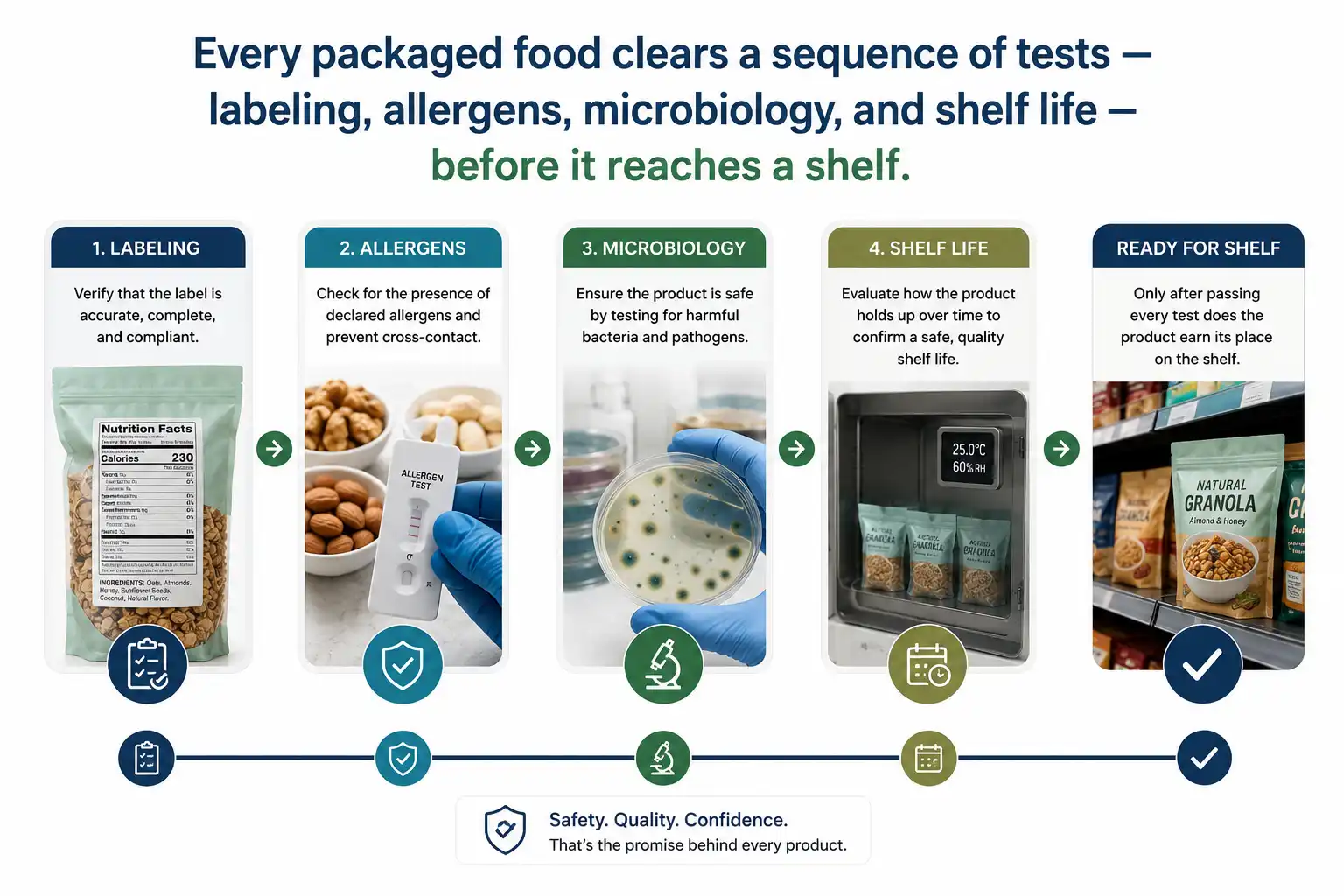
This guide walks through the food product testing and compliance steps in the order most new products tackle them. Moreover, it's written for the full range of food launchers emerging brands and startups, copackers producing for clients, and importers bringing products into the U.S. market. Use it as a planning checklist; however, your exact requirements depend on your product category, ingredients, and process, so confirm specifics with an accredited lab and, where needed, a regulatory consultant. One practical note up front: a full food product testing panel can take several weeks to complete and shelf-life studies can take far longer so build testing into your timeline early, not the week before your first purchase order ships.
If a co-packer makes your product, the testing responsibilities can blur but the brand owner is ultimately accountable for what's on the shelf. Many co-packers run their own food safety and micro programs, yet nutritional analysis, label compliance, and claim substantiation often fall to the brand. Spell out who does what in writing, and never assume a test was run unless you've seen the report.
Step 1 — Before food product testing: register your facility
Testing supports compliance, but compliance starts with registration. Specifically, under the FDA Food Safety Modernization Act (FSMA), any domestic or foreign facility that manufactures, processes, packs, or holds food for U.S. consumption must register with the FDA and renew that registration every even-numbered year between October 1 and December 31. In short, food product testing sits on top of this foundation; it cannot replace it.
Most facilities also need a written food safety plan under the Preventive Controls for Human Food rule: a hazard analysis identifying biological, chemical, and physical hazards, plus the preventive controls (including allergen controls) that address them. Your testing program is the evidence that those controls actually work.
If you're making shelf-stable acidified foods (like salsas, pickles, or sauces) or low acid canned foods, you'll also need a Food Canning Establishment (FCE) registration and process filings plus pH and water activity testing to support your scheduled process.
Step 2 — Nutrition Facts & label testing
Nearly every packaged food sold in the U.S. needs a compliant Nutrition Facts panel built to the FDA's 21 CFR Part 101 format. The most reliable way to get accurate numbers is laboratory nutritional analysis sending your finished product to a lab that measures the actual nutrient content rather than estimating from a database.
What a nutritional analysis panel typically covers
- Macronutrients: calories, total fat, saturated and trans fat, protein, total carbohydrate, dietary fiber, and total and added sugars.
- Mandatory micronutrients: the current format requires Vitamin D, calcium, iron, and potassium declared by actual amount and % Daily Value.
- Sodium and cholesterol, both of which carry their own Daily Values and labeling rules.
Beyond the panel itself, your label needs an accurate ingredient statement (in descending order by weight), correct serving size based on the FDA's reference amounts, and proper formatting. Furthermore, any nutrient content claim ("good source of fiber," "low sodium") or health claim has to be substantiated by your food product testing data.
If your label says "high protein" or "no added sugar," that's a regulated claim. The lab values behind it need to support the statement both the average and the variation across batches or the claim is misbranding.
Step 3 — Allergen verification
U.S. law recognizes nine major food allergens, and each must be clearly declared when present. The original eight came from the Food Allergen Labeling and Consumer Protection Act (FALCPA) of 2004; sesame was added as the ninth by the FASTER Act, effective January 1, 2023. As a result, allergen checks are now a core part of any food product testing program.
| The nine major allergens | Common sources | Label status |
|---|---|---|
| Milk | Dairy, casein, whey | Must declare |
| Eggs | Albumin, mayonnaise | Must declare |
| Fish | Bass, cod, flounder | Must declare |
| Crustacean shellfish | Crab, lobster, shrimp | Must declare |
| Tree nuts | Almond, walnut, pecan | Must declare |
| Peanuts | Peanut flour, oil* | Must declare |
| Wheat | Flour, gluten, starch | Must declare |
| Soybeans | Soy lecithin, tofu | Must declare |
| Sesame | Seeds, tahini, oil | 9th — since 2023 |
Declaration alone isn't the whole job. If your facility handles allergens that aren't in a given product, you need allergen control verification swab and product testing to confirm your cleaning and changeover procedures actually prevent cross-contact. This is where many launches stumble: the label is correct, but the shared line tells a different story.
Undeclared allergens are consistently among the leading reasons for U.S. food recalls. Testing your finished product and your line for the allergens you don't intend to include is cheap insurance against an expensive, brand-damaging recall.
Step 4 — Microbiological & pathogen testing
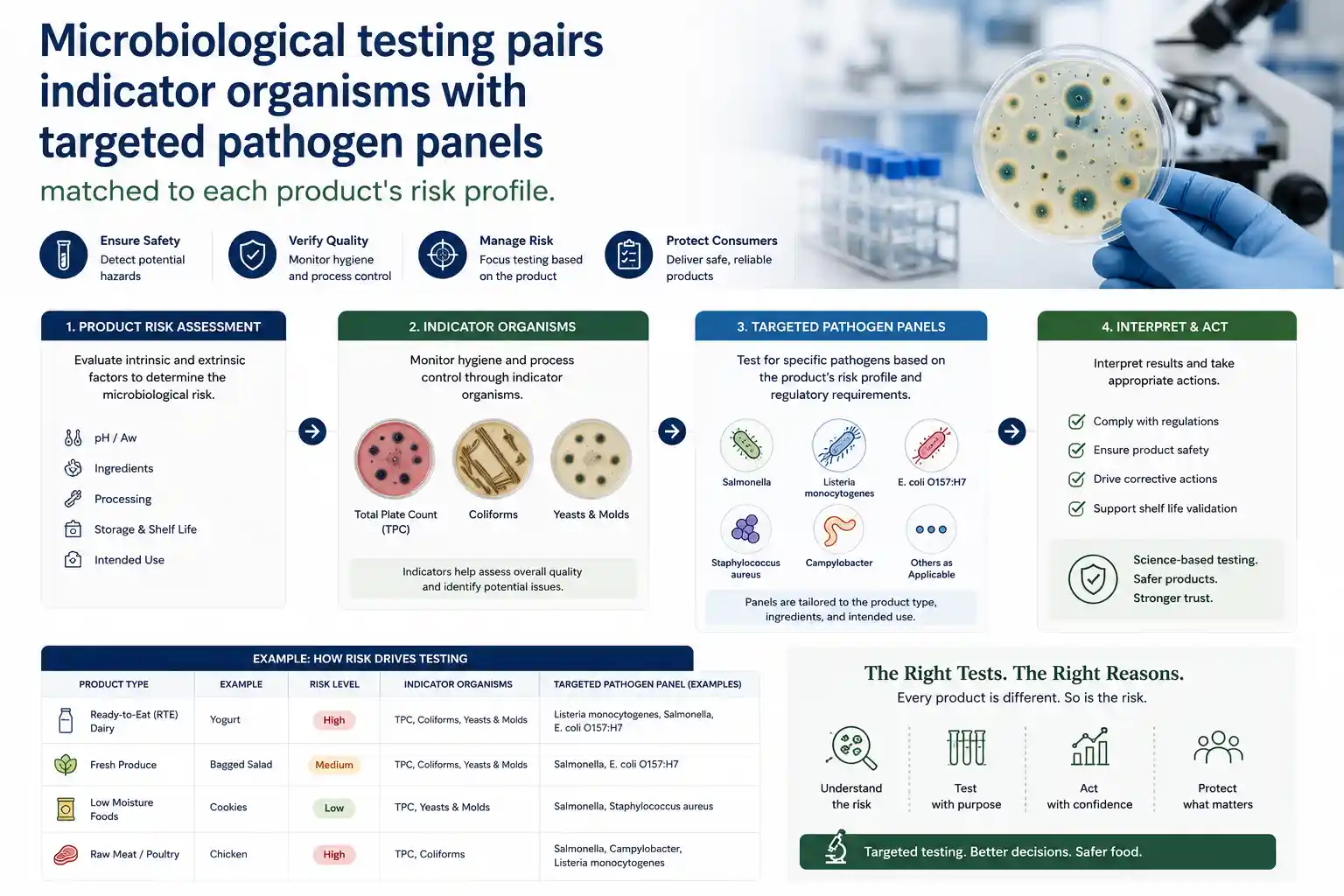
Microbiological testing answers the most basic safety question: is your product safe to eat? The exact panel depends on your product type, but a launch program usually combines indicator organisms (which signal sanitation problems) with pathogen testing (which catches the organisms that actually make people sick).
A typical launch micro panel in food product testing
- Indicator tests: Aerobic Plate Count (APC), total coliforms, E. coli, and yeast & mold — your general hygiene and spoilage indicators.
- Pathogens: Salmonella, Listeria monocytogenes, and pathogenic E. coli (such as O157:H7), matched to your product's risk profile.
- Environmental monitoring: swabbing the production environment especially for ready to eat foods to catch Listeria harborage before it reaches product.
Ready-to-eat products, anything with a high water activity, and refrigerated items generally need the most rigorous microbiological scrutiny. By contrast, shelf-stable, low-moisture products carry lower microbial risk yet they still need food product testing to verify safety.
Step 5 — Shelf-life & stability testing
Your "best by" or expiration date is a claim, and like any claim it needs evidence. Shelf-life testing stores your product under defined conditions and tracks how its safety and quality change over time, so you can set a date you can defend.
- Real-time studies hold the product at normal storage conditions for the full intended shelf life the gold standard, but slow.
- Accelerated studies use elevated temperature and humidity to estimate shelf life faster, useful when you can't wait a year to launch.
- Water activity & pH measurements underpin the whole study they determine whether your product is shelf-stable in the first place and which pathogens it can support.
A well-run shelf-life study watches several things at once: microbial growth, chemical changes like rancidity (peroxide value), moisture migration, texture, color, and flavor. The result is a date that protects both your customers and your brand.
Water activity (Aw) is the single most useful number for predicting shelf life and microbial risk. If your product sits near the Aw 0.85 line, its classification — and its required controls — can change. We cover this in depth in our guide to water activity vs. moisture, but the short version: a validated Aw reading is foundational to a defensible shelf-life claim.
Step 6 — Chemical & contaminant testing
Depending on your ingredients and category, you may need chemical and contaminant testing to verify that your product is free of chemical contaminants at unsafe levels. In addition to protecting consumers, this kind of food product testing supports any "clean" positioning your brand makes.
If your formulation uses preservatives, synthetic dyes, or antioxidants, build in food additives and preservatives testing to confirm each one stays within its FDA limit and matches your label declarations.
| Test | When it matters | When it applies |
|---|---|---|
| Heavy metals | Lead, cadmium, arsenic, mercury — key for spices, baby food, chocolate, rice, supplements | High-risk categories |
| Pesticide residues | Produce-based products, botanicals, teas | By category |
| Fungal Toxins | Grains, nuts, dried fruit, spices (e.g. aflatoxin) | By category |
| Nutritional / fatty acid profile | Oils, fats, omega-3 claims | When you make a claim |
If you're selling into California, also factor in Proposition 65, which has its own safe-harbor levels for heavy metals and other listed substances a reading that's fine federally can still trigger a Prop 65 warning obligation in that state.
Step 7 — Traceability & ongoing monitoring
Launch testing proves your first production runs are safe and compliant. However, staying compliant means building systems that keep proving it. Therefore, two pieces matter most:
First, traceability. The FSMA Section 204 Food Traceability Rule sets enhanced recordkeeping requirements for foods on the FDA's Food Traceability List, so contaminated product can be identified and pulled quickly. If your product or its ingredients appear on that list, you'll need to capture specific data at key points in your supply chain so build those records in from day one rather than retrofitting them later. Note that the rule's compliance and enforcement timelines have been in flux, so check the current FDA compliance date for your situation rather than relying on an older one.
Second, ongoing verification. A launch panel is a snapshot; a monitoring program is the movie. Consequently, routine food product testing micro checks, environmental swabbing, label re-verification when formulas change, and periodic contaminant screening keeps your product compliant batch after batch, and gives you the documentation retailers and auditors increasingly expect in digital form.
Step 8 — Your food product testing checklist in one place
Here's the full food product testing sequence in one place. Admittedly, few products need every single test — but every product launch should consciously decide which ones apply and document why.
The packaged food launch testing checklist
- Register your facility with the FDA and prepare your food safety plan (plus FCE registration for acidified/low-acid canned foods).
- Run a nutritional analysis and build a 21 CFR 101-compliant Nutrition Facts panel and ingredient statement.
- Verify allergens — declare all nine majors present, and test your line for cross-contact with the ones you exclude.
- Test microbiologically — indicator organisms plus pathogens matched to your product's risk, with environmental monitoring for RTE foods.
- Validate shelf life with a real-time or accelerated study, anchored by water activity and pH.
- Screen for chemical contaminants relevant to your category — heavy metals, pesticides, fungal toxins — and check Prop 65 if selling in California.
- Test additives & preservatives — confirm colors, preservatives, and antioxidants are within FDA limits and correctly declared with food additives testing.
- Build traceability and a monitoring program so compliance holds beyond the first batch.
Ultimately, treat food product testing as part of product development, not a box to check at the end. Launching with a complete, documented testing program is what separates brands that scale smoothly from those that stall on a recall or a failed retailer audit. Finally, an accredited lab can help you map exactly which tests your specific product needs.
Government sources & further reading
The requirements in this checklist come from U.S. government primary sources. For the authoritative detail, go to the originals:
- FDA — Registration of Food Facilities — who must register, biennial renewal, and FSMA requirements.
- FDA — FSMA Section 204 Food Traceability Rule — enhanced recordkeeping for foods on the Food Traceability List.
- FDA — Food Allergies & the Nine Major Allergens — FALCPA, the FASTER Act, and sesame labeling.
- FDA — Nutrition Facts Label (21 CFR 101) — the current panel format and required nutrients.
- FDA — Preventive Controls for Human Food — hazard analysis and the food safety plan.
- USDA FSIS — Shelf-Stable Food Safety — how water activity and processing keep products stable.