
Water Activity vs. Moisture: What Each Tells You About Shelf Life
Two products can hold the exact same amount of water and spoil at completely different rates. That gap is why moisture content and water activity (Aw) are not interchangeable and why only one of them predicts safety.
Moisture content tells you how much water is in a food. Water activity tells you how much of that water is actually available to microbes and chemical reactions. Only the second one predicts spoilage and it's written into U.S. food law.
The core difference, in one sentence
A teaspoon of honey and a slice of cucumber can carry similar total water, yet honey sits on a shelf for years while cucumber rots in days. The honey's sugar binds its water tightly, leaving almost none free for bacteria, yeast, or mold to use. That bound-versus-free distinction is exactly what water activity captures and moisture content cannot.
What each measurement actually means
Moisture content — total water, by weight
Moisture content is the total mass of water in a product, found by drying a sample (loss-on-drying) or by Karl Fischer titration. It's excellent for process control, texture, and yield but it counts bound water locked into sugars, salts, proteins, and starches, which microbes can never reach.
Water activity (Aw) — free water, on a 0–1 scale
Water activity is the ratio of the food's vapor pressure to pure water's at the same temperature, on a scale from 0 to 1. It reflects the energy state of water how readily it can fuel spoilage and maps directly onto microbial growth limits. Because of that, two products at the same moisture percentage can behave completely differently in storage.
Why water activity wins for safety
Every microorganism has a minimum Aw below which it simply cannot grow. Lower the available water past that line by drying, or by adding solutes like salt or sugar that bind it and growth stops, regardless of how much total water remains.
- What it answers: how much water is available for microbial growth and chemical reactions.
- Best used for: shelf-life prediction, pathogen growth control, and regulatory classification.
- Why it wins: it lines up directly with the growth thresholds of bacteria, yeast, and mold.
Side-by-side comparison
| Attribute | Moisture content | Water activity (Aw) |
|---|---|---|
| Measures | Total water, by weight | Free, available water (0–1) |
| Predicts shelf life? | Not reliably on its own | Yes — directly correlated |
| Predicts microbial growth? | No | Yes |
| Typical method | Loss-on-drying, Karl Fischer | Capacitance / dew-point |
| Best role | Process & formulation control | Safety, stability, compliance |
| Honey reads | High moisture | Low Aw (~0.6) — shelf-stable |
The Aw scale & safety thresholds
Different spoilage organisms shut off at different Aw levels. These are the practical breakpoints product developers work around:
| Aw range | What it means | Risk |
|---|---|---|
| 0.91 – 1.00 | Supports most bacteria, including Salmonella and Listeria | High |
| 0.86 – 0.90 | Staphylococcus aureus and many spoilage organisms still grow | High |
| 0.70 – 0.85 | Most bacteria stop; mold and yeast can still grow | Moderate |
| 0.60 – 0.70 | Below the limit for nearly all microbial growth | Low |
| Below 0.60 | Generally shelf-stable without refrigeration | Low |
The headline number for regulators and food-safety teams is 0.85. At or below it, a product is generally not classified as a TCS (Time/Temperature Control for Safety) food and is treated as shelf-stable. Above it, the product needs additional controls, validation, or refrigeration.
Common foods and their typical water activity
Note how total moisture and Aw don't track together — honey is wet but stable, while fresh meat's water is almost fully available:
| Food | Typical Aw | What it tells you |
|---|---|---|
| Fresh meat & fish | 0.98 – 0.99 | Highly perishable; supports pathogens |
| Fresh fruit & vegetables | 0.97 – 0.99 | Perishable; needs refrigeration |
| Bread | 0.94 – 0.97 | Mold-prone within days at room temp |
| Aged / hard cheese | 0.85 – 0.93 | Near the TCS line; depends on type |
| Jam & preserves | 0.80 – 0.85 | Sugar binds water; shelf-stable sealed |
| Dried fruit | 0.60 – 0.75 | Yeast/mold possible; bacteria inhibited |
| Honey | 0.50 – 0.60 | High moisture, low Aw — very stable |
| Crackers & dry snacks | 0.10 – 0.30 | Shelf-stable; quality limited by staling |
| Powdered milk / seasonings | 0.20 – 0.40 | Caking is the main risk, not microbes |
The FDA & USDA rules that hinge on Aw
Water activity isn't just a quality metric it's written into U.S. food law. The 0.85 threshold defines how the FDA classifies several product categories:
- Low-acid canned foods (21 CFR 113): equilibrium pH above 4.6 and a water activity above 0.85. These require a scheduled thermal process.
- Acidified foods (21 CFR 114): low-acid foods acidified to a finished pH of 4.6 or below, with Aw above 0.85 salsas, pickles, dressings, and many sauces.
- TCS / Potentially Hazardous Foods (FDA Food Code): foods above Aw 0.85 (and pH above 4.6) generally require time and temperature control.
The FDA's Inspection Technical Guide is explicit: if the water activity of a finished product is controlled to 0.85 or less, it falls outside the regulations of 21 CFR Parts 108, 113, and 114. Most foods naturally sit above 0.95 more than enough available water for bacteria, yeast, and mold so reaching shelf-stability means deliberately driving that number down.
USDA FSIS: meat & poultry follow the same logic
For meat and poultry, USDA's Food Safety and Inspection Service treats water activity as the more reliable safety measure. In its jerky guidance, FSIS states plainly that the older moisture-to-protein ratio is an inappropriate indicator of shelf-stability, and that water activity is the better measure of available water for microbial growth. Producers are expected to monitor or verify Aw after drying to demonstrate the product has reached shelf-stability.
If your product sits near the 0.85 line, get it tested by an accredited lab. A reading on the wrong side of that threshold changes your entire regulatory pathway from labeling to required process filings.
How water activity is measured
Water activity is measured by sealing a sample in a small chamber and letting it reach equilibrium with the air around it. Once the air and the food stop exchanging moisture, the relative humidity of that headspace expressed as a decimal is the water activity. An Aw of 0.80 means the vapor pressure above the food is 80% of pure water's at the same temperature. Because that reading is only as reliable as the method behind it, most brands send samples to an accredited food quality testing lab that measures Aw alongside pH, moisture, and the other parameters that define product stability.
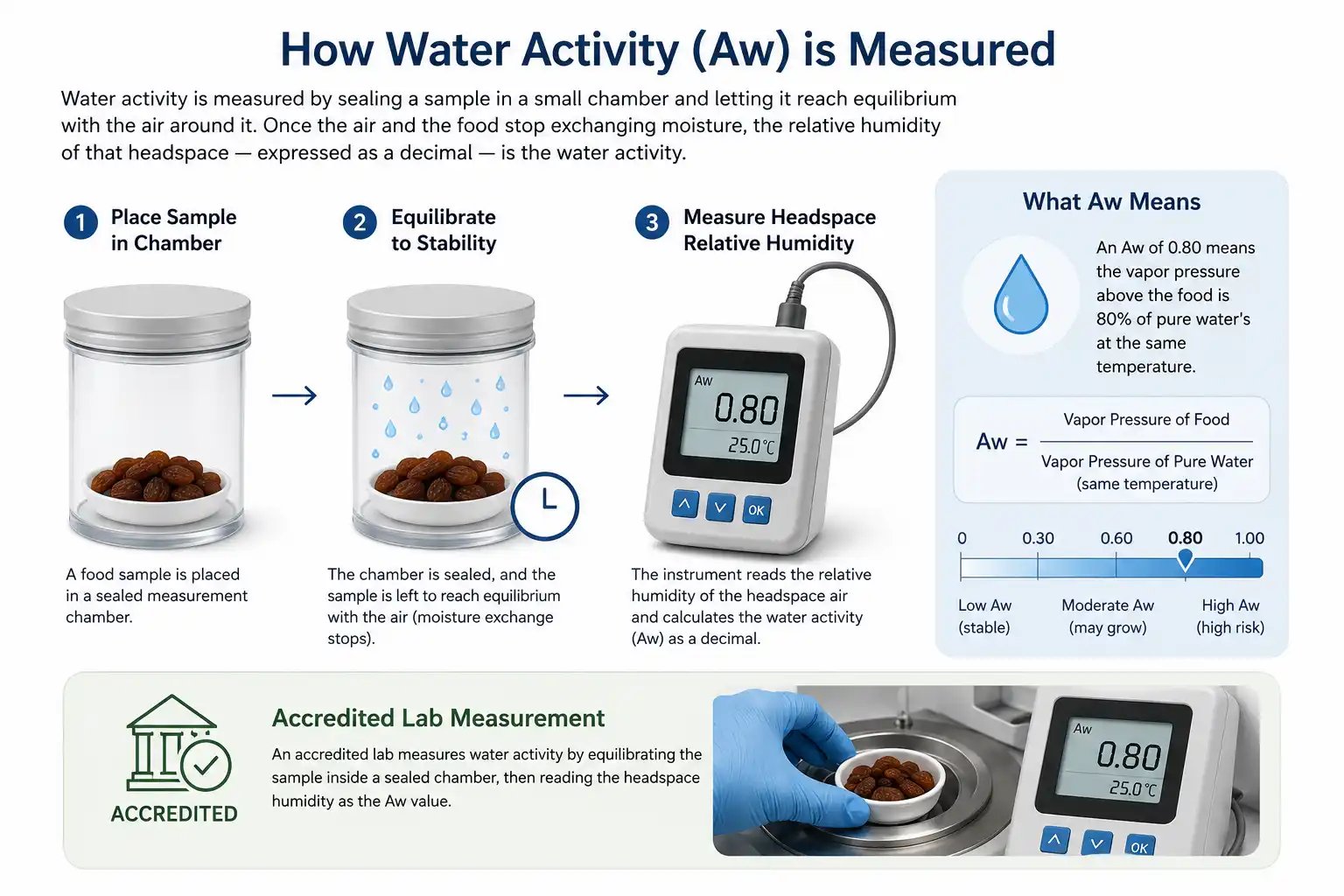
Two instrument types dominate accredited labs:
- Capacitance sensors read the change in an electrical property as the sensor equilibrates with the headspace. Fast and robust for routine QC.
- Chilled-mirror dew-point hygrometers detect the exact temperature at which condensation forms on a cooled mirror, then derive Aw. Generally the reference method for precision.
Because Aw rises with temperature, readings are always taken at a controlled, recorded temperature. This is also why true real-time inline Aw testing remains impractical with current technology: the sample has to reach equilibrium first. The standardized procedure is defined in ISO 18787 and AOAC methods, which accredited labs follow for defensible results.
How manufacturers lower water activity
If a product needs to clear the 0.85 line or go lower for mold control formulators have a handful of well-established levers. Each works by removing free water or binding it so microbes can't use it:
Four ways to drive water activity down
- Drying & dehydration — the most direct route. USDA FSIS guidance describes drying meat snacks to an Aw of 0.85 or below (often under 0.70) to reach shelf-stability.
- Adding solutes (salt or sugar) — dissolved salt and sugar bind free water osmotically, how cured meats, jams, and syrups stay stable despite high total moisture.
- Humectants (glycerol, sorbitol) — hold water in the product while keeping it unavailable to microbes; common in intermediate-moisture foods.
- Freezing — converting liquid water to ice removes it from the available pool.
The catch: every lever also changes texture, flavor, and yield. Drive Aw too low and jerky turns to leather; add too much sugar and you change the product entirely. That trade-off is why developers map a sorption isotherm the curve linking moisture content to water activity for their recipe then pick packaging that holds the target Aw through storage.
Two products at the same moisture percentage can land on opposite sides of 0.85 depending on how much salt, sugar, or starch is binding that water. Only a measured Aw value tells you where you actually are on the safety scale.
Watch: the difference in two minutes
If you'd rather see it explained visually, a short video makes the moisture-versus-availability point quickly. Once the distinction clicks, the practical question becomes simple: what is your product's actual Aw?
Why smart manufacturers test both
Choosing one over the other is a false choice they answer different questions, and together they give you the full picture. Run a full shelf-life study once, correlating moisture and Aw against actual product failure for your specific formulation. After that, you can often use quick, lowcost Aw readings alone as an ongoing indicator of shelf life — and as a check on incoming raw ingredients and mid-production samples to catch deviations early.
- Use moisture content to keep your process and texture on spec, batch after batch.
- Use water activity to set and defend shelf life, classify your product, and prove safety.
- Use both to build sorption isotherms, choose the right packaging, and stop guessing.
Moisture content keeps your process consistent; water activity keeps your product safe and legal. The strongest programs measure both and lean on Aw for every shelf-life and compliance decision.
Government sources & further reading
Every regulatory point above comes straight from U.S. government primary sources. For the authoritative wording, go to the originals:
- FDA — Water Activity (aw) in Foods, Inspection Technical Guide — the definition of water activity and the 0.85 threshold that exempts a finished product from 21 CFR Parts 108, 113, and 114.
- eCFR — 21 CFR Part 114, Acidified Foods — the federal definition of low-acid and acidified foods, both keyed to a water activity above 0.85.
- FDA — Acidified & Low-Acid Canned Foods Guidance — the hub for FDA guidance on classification, scheduled processes, and filing requirements.
- USDA FSIS — Shelf-Stable Food Safety — how removing available water keeps microorganisms from multiplying in dried and preserved foods.
- USDA FSIS — Compliance Guideline for Meat & Poultry Jerky — FSIS's position that water activity, not moisture-to-protein ratio, is the appropriate indicator of shelf-stability.
- FDA - Evaluation and Definition of Potentially Hazardous Foods (TCS) the science behind the pH and Aw cutoffs used to classify foods that need temperature control.