
Shelf Life Testing &
Stability Studies
Scientifically determine your product's expiration date with accredited shelf life testing protocols. Accelerated and Real-Time stability programs anchored on PJLA-accredited Water Activity, pH, Peroxide Value, and Free Fatty Acid methods.
Validate with a Trusted Shelf Life Testing Lab
AGT Food Labs provides accurate stability data so that you can determine how long your product maintains its quality, safety, and nutritional value. In short, whether you are launching a new product or changing packaging, our stability program produces the data needed to print "Best By" or "Expiration" dates with confidence.
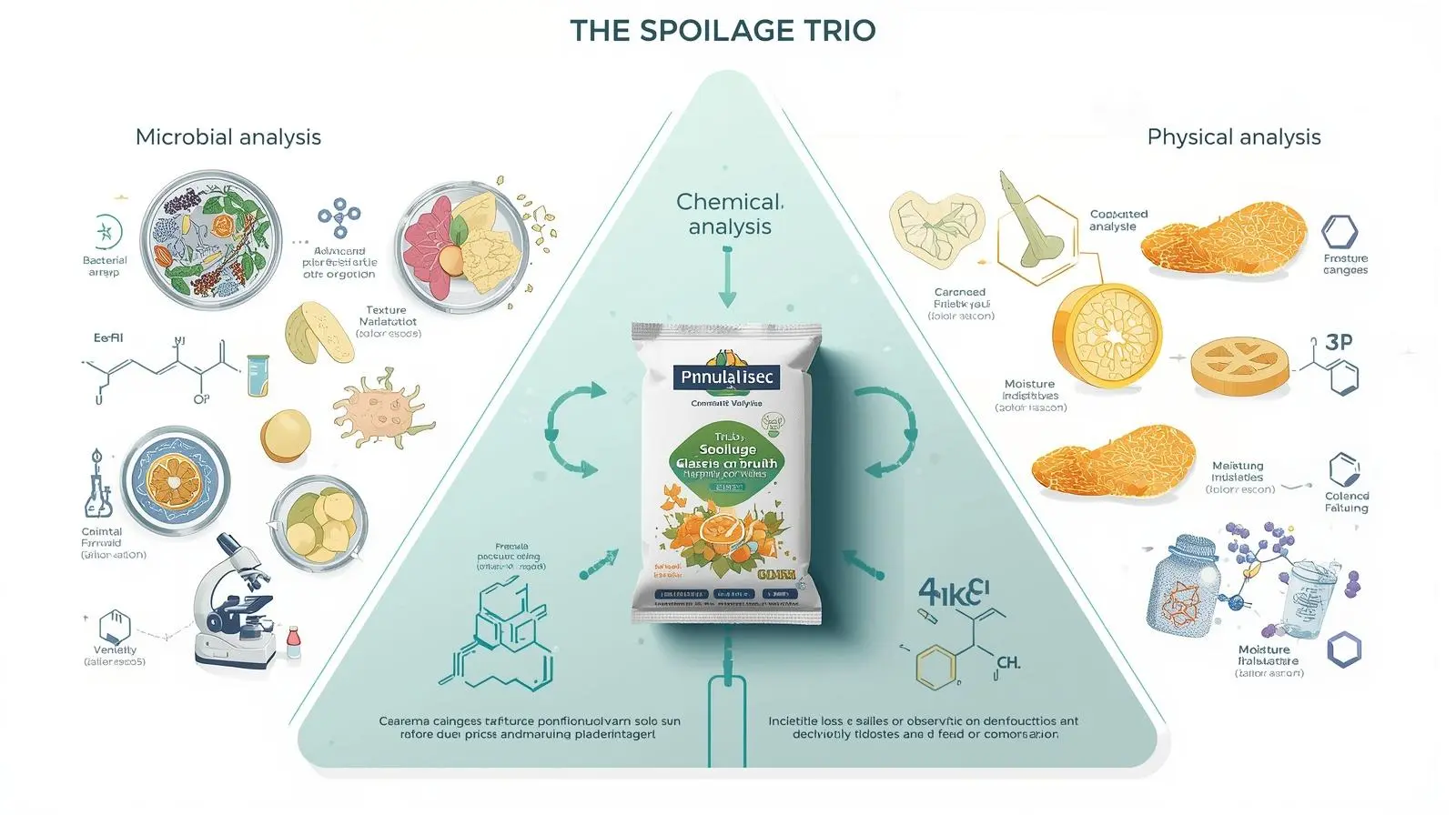
To do this, we monitor the "Spoilage Trio" microbial growth, chemical degradation (rancidity), and organoleptic changes - to predict exactly when your product fails. Moreover, the chemical-stability anchors (Water Activity, pH, Peroxide Value, Free Fatty Acids, Titratable Acidity) are all run in-house under our PJLA scope. Water activity is the strongest single predictor of microbial stability our explainer on water activity vs moisture content covers why the two numbers are not interchangeable.
Scope note: Our PJLA ISO/IEC 17025:2017 accreditation (Cert L26-535) covers the stability anchors used in shelf life testing - Water Activity (AOAC 978.18, SOP 044), pH (AOAC 981.12, SOP 036), Peroxide Value (AOCS Cd 8b-90, SOP 067), Free Fatty Acids (AOCS Ca 5a-40, SOP 063), Titratable Acidity (SOP 064), Aerobic Plate Count (AOAC 990.12), Yeast & Mold (AOAC 2014.05), and Vitamins A/C/D (HPLC), plus the 14-element ICP-MS mineral panel. By contrast, only sensory and physical (texture) analysis is coordinated through our partner laboratory network and consolidated into one shelf-life report.
Our Shelf Life Testing Process
From protocol design to the final report, we guide you through determining your product's shelf life.
Why Shelf Life Testing is Critical
For example, retailers like Walmart, Whole Foods, and Costco require scientific proof of your expiration dates. In fact, guessing your shelf life can lead to premature spoilage, costly recalls, and consumer illness.
Ultimately, a professional stability study not only ensures regulatory compliance but also protects your brand reputation by ensuring customers experience your product exactly as intended - from the first day to the last.
Our Shelf Life Testing Services
Comprehensive aging protocols matched to your timeline and product type.

Accelerated Shelf Life Testing (ASLT)
Need to launch quickly? In that case, we use the Arrhenius Equation (Q10 Model) to predict shelf life. Specifically, by incubating samples at elevated stress (e.g., 35°C, 45°C, or 55°C), we increase the rate of chemical degradation to simulate months of aging in just weeks.
The Science: Based on a standard Q10 factor, we mathematically project your expiration date, allowing you to get to market faster while waiting for real-time validation.
- New Product Launches
- Dry Goods (Low Water Activity)
- Fats & Oils (PV / FFA tracking)
- Rapid Prototyping
Real-Time Stability Studies
The only way to truly validate an accelerated prediction. Indeed, real-time shelf life testing stores your samples for the full duration under strict ICH Climatic Zone conditions (e.g., 25°C / 60% RH for ambient) to mirror your exact supply chain environment.
For this reason, we recommend running real-time studies in parallel with ASLT to confirm your label claims satisfy regulatory and retailer audits.
- Perishable Foods (Dairy, Meat)
- Final Regulatory Validation
- Frozen Products
Microbial, Chemical & Physical Analysis
We don't just wait for mold. Instead, we use a holistic approach to define "End of Life" by monitoring the three pillars of quality degradation:
- Chemical & Nutrient (PJLA): Water Activity, pH, PV, FFA, Titratable Acidity, Minerals, Vitamins A/C/D
- Microbial (PJLA): APC, Yeast, Mold
- Physical (Partner): Texture, Color Fading
Accelerated vs. Real-Time: Which Do You Need?
Ultimately, this side-by-side comparison helps you choose the right shelf life testing protocol for your timeline and product type.
| Factor | Accelerated (ASLT / Q10) | Real-Time Stability |
|---|---|---|
| Speed | Weeks (months of aging simulated) | Full shelf-life duration |
| Method Basis | Arrhenius / Q10 model at elevated temperature (35–55°C) | ICH climatic-zone storage (e.g., 25°C / 60% RH) |
| Best For | New launches, dry goods, fats & oils, rapid prototyping | Perishables, frozen products, final regulatory validation |
| Regulatory Weight | Predictive / provisional projection | Gold-standard confirmation |
| Recommended Use | Run first to reach market faster | Run in parallel to validate the label claim |
Industries We Serve
Shelf life testing for the food & beverage categories where stability is the highest commercial risk.



Analytical Parameters Monitored
Specifically, validated AOAC and AOCS methods are used to track degradation across each pull point.
| Test Parameter | Method Reference | Scope | Purpose in Shelf Life |
|---|---|---|---|
| Water Activity (Aw) | AOAC 978.18, SOP 044 | ✅ PJLA-Accredited | Predicts microbial stability & staling risk |
| pH Stability | AOAC 981.12, SOP 036 | ✅ PJLA-Accredited | Monitors fermentation or spoilage shifts |
| Peroxide Value (PV) | AOCS Cd 8b-90, SOP 067 | ✅ PJLA-Accredited | Measures initial oxidative rancidity in fats & oils |
| Free Fatty Acids (FFA) | AOCS Ca 5a-40, SOP 063 | ✅ PJLA-Accredited | Measures hydrolytic rancidity (off-flavors) |
| Titratable Acidity | AOCS Ca 5a-40, SOP 064 | ✅ PJLA-Accredited | Acid balance & spoilage in dairy, sauces, beverages |
| Aerobic Plate Count (APC) | AOAC 990.12 | ✅ PJLA-Accredited | General bacterial growth indicator |
| Yeast & Mold | AOAC 2014.05 | ✅ PJLA-Accredited | Primary spoilage in acidic / dry foods |
| Vitamin Profiling (HPLC) | AOAC 992.06 / 2012.22 / 2016.05 | ✅ PJLA-Accredited | Verifies Vitamin A/C/D label claims over time |
Industry Compliance
Meeting the strict requirements of retailers and regulators.
Retailer Standards
For instance, our shelf life testing reports meet the verification standards required by major retailers like Whole Foods, Walmart, Costco, and Amazon.
Challenge Studies
In addition, pathogen-inoculation challenge studies (Listeria / Salmonella) are coordinated through our partner microbiology network and integrated into the stability report.
Packaging Integrity
Meanwhile, we assess container-closure integrity to ensure seal failures do not compromise the product during its shelf life window.
Frequently Asked Questions
Common questions about Shelf Life and Stability Testing.
Which shelf life testing methods does AGT run in-house under PJLA accreditation?
How long does shelf life testing take?
How much does shelf life testing cost?
How do I prepare and ship samples for a shelf life study?
Don't Guess Your Expiration Date.
Get scientific validation for your product with our accredited shelf life testing program.
Request a Stability Quote