
Nutritional Analysis
and Food Labeling
Accredited nutritional analysis for FDA Nutrition Facts labels, performed at our Houston, TX laboratory. Our PJLA ISO/IEC 17025:2017 scope covers minerals (Sodium, Calcium, Iron, Potassium), cholesterol, caffeine, protein, fat, fatty acids, dietary fiber, total sugars, and Vitamins A, C & D.
Accredited Nutritional Analysis for FDA Nutrition Facts Labels
Accurate nutritional analysis and food labeling is required for compliance under the FDA's Nutrition Labeling and Education Act (NLEA, 21 CFR 101.9). AGT Food Labs' PJLA ISO/IEC 17025:2017 scope (Cert L26-535) covers every mandatory Nutrition Facts nutrient that requires laboratory measurement: the four label minerals (Sodium, Calcium, Iron, Potassium), plus Cholesterol, Protein, Total Fat, Saturated & Trans Fat (fatty-acid profile), Total Dietary Fiber, Total Sugars, and Vitamin D. Vitamins A and C are also on scope for voluntary declarations, along with Caffeine for beverages and supplements.
Each analyte is measured under an accredited method: ICP-MS for the mineral panel (AOAC 985.01 / 993.14, SOP 047), GC-FID for cholesterol (AOAC 994.10, SOP 080) and the fatty-acid profile (AOAC 996.06, SOP 079), HPLC for caffeine (AOAC 979.08 / ISO 20481, SOP 048), titrimetric determination for protein (AOAC 2001.11, SOP 068), gravimetric fat (AOAC 922.06, SOP 069), enzymatic-gravimetric dietary fiber (AOAC 985.29, SOP 071), and HPLC for total sugars and vitamins. Calories and Total Carbohydrate are calculated from these measured values per FDA convention. Added Sugars is documented from your formulation and ingredient records, because no laboratory method can separate added from naturally occurring sugars. You can round out label compliance with food allergen testing and verify food additives for clean-label declarations.
Scope note: Nutritional analysis is performed at our Houston, TX facility under PJLA ISO/IEC 17025:2017 accreditation (Accreditation No. 117946, Cert L26-535). These methods are accredited to ISO/IEC 17025:2017 but are not included in our FDA LAAF-recognized scope. If your submission requires a LAAF-recognized method, contact us before shipping and we will confirm coverage for the parameter you need.
Why Nutritional Labeling Matters
Building consumer trust through transparent nutrient reporting.
Regulatory Compliance
Meet FDA 21 CFR 101.9 requirements for nutrient declaration using accredited laboratory data rather than database estimates.
Health Claims
Substantiate nutrient content claims such as "Low Sodium," "Low Cholesterol," "High Protein," or "Excellent Source of Fiber" with defensible label data.
Reformulation
Track how recipe changes affect minerals, cholesterol, caffeine, fat, protein, sugars, and fiber during product development.
Accredited Services for Nutritional Analysis and Food Labeling
Mineral panel by ICP-MS, cholesterol by GC-FID, and caffeine by HPLC — all under our PJLA ISO/IEC 17025:2017 scope.
Mineral Panel by ICP-MS for Nutrition Facts Labels

Our ICP-MS mineral panel under AOAC 985.01 / 993.14 (SOP 047) quantifies the four mandatory minerals on the Nutrition Facts panel — Sodium, Calcium, Iron, and Potassium — in a single run. The same method reports a further nine elements: six that matter for fortification verification and formulation control, and three that serve as quality and packaging-migration indicators. You can validate nutrient stability over time with shelf life stability studies.
Sodium (Na), Calcium (Ca), Iron (Fe), Potassium (K).
Magnesium (Mg), Zinc (Zn), Copper (Cu), Manganese (Mn), Selenium (Se), Chromium (Cr).
Aluminum (Al), Tin (Sn), Nickel (Ni) — reported for process and packaging-contact monitoring rather than nutrient declaration.
AOAC 985.01 / 993.14 by ICP-MS (SOP 047), under PJLA ISO/IEC 17025:2017 accreditation, Cert L26-535. SOP 051 (AOAC 2015.06, Microwave Digestion ICP-MS) extends the panel to include Molybdenum (Mo).
Sample Size: 50–100 g | LOQ: < 1 ppm (varies by element) | Shipping: Ambient
5–7 Business Days · Rush available on request
FDA Nutrition Facts label generation, "Low Sodium" / "High Iron" / "Excellent Source of Calcium" claim substantiation, fortified product verification, sports nutrition and dietary supplement potency confirmation, and reformulation studies.
Cholesterol Testing by GC-FID

Cholesterol is a mandatory declaration on the FDA Nutrition Facts panel, reported in milligrams per serving. We measure it directly by GC-FID under AOAC 994.10 (SOP 080) rather than estimating it from database values. The AOAC 996.06 fatty-acid profile (SOP 079) separately resolves saturated and trans fat, so your fat and cholesterol lines each come from an accredited determination.
Cholesterol — AOAC 994.10 (SOP 080, GC-FID). Companion fatty-acid profile for saturated and trans fat — AOAC 996.06 (SOP 079, GC-FID). Both under PJLA ISO/IEC 17025:2017 accreditation, Cert L26-535.
Sample Size: 100–200 g | Matrices: Meat and poultry, dairy, eggs and egg products, bakery, oils and fats, prepared meals | Shipping: Chilled or frozen for perishables
5–7 Business Days · Rush available on request
Mandatory cholesterol declaration on Nutrition Facts panels, "Low Cholesterol" and "Cholesterol Free" claim substantiation under 21 CFR 101.62, egg and dairy replacement verification, and reformulation studies targeting reduced cholesterol.
Caffeine Quantification by HPLC
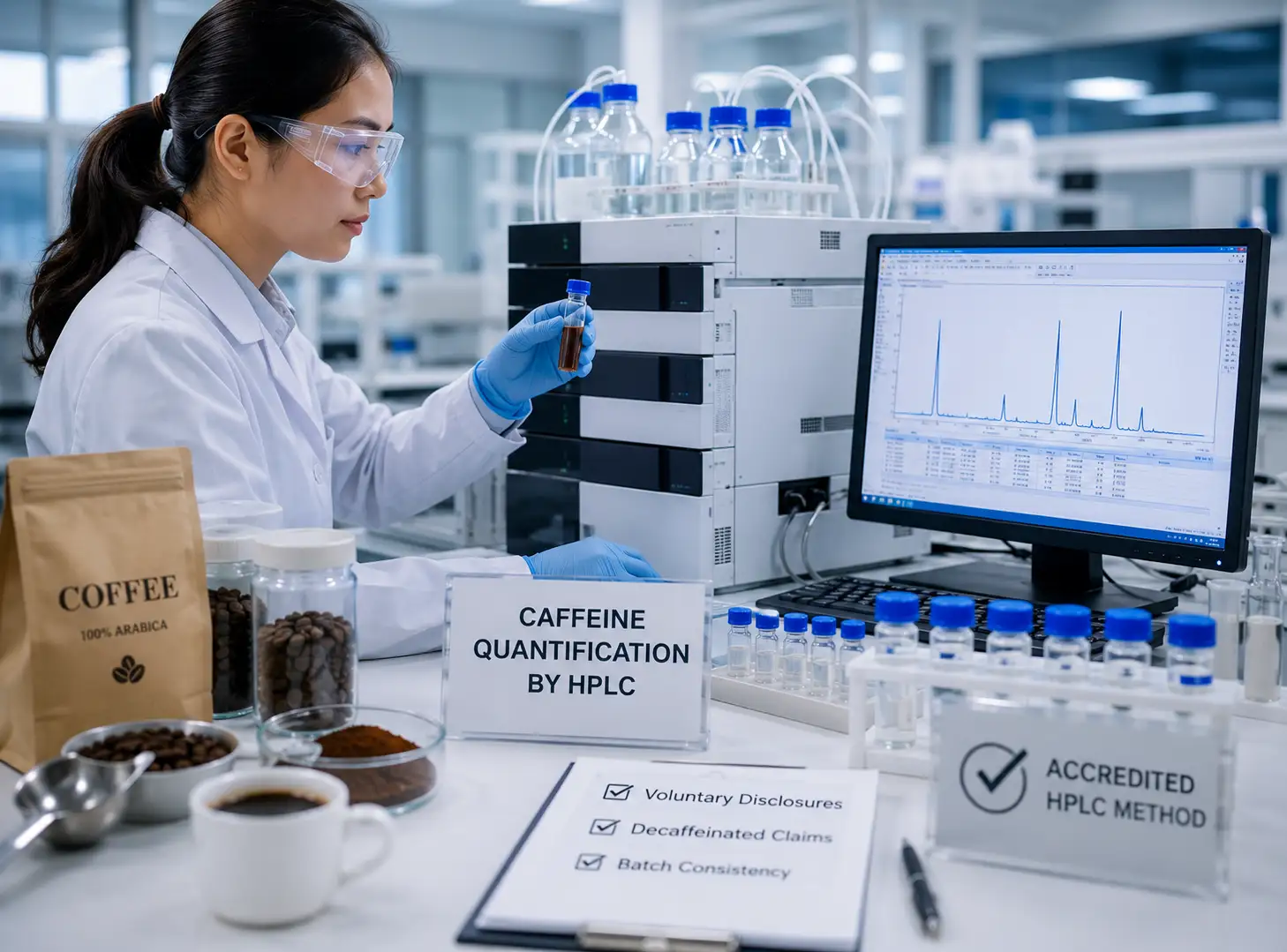
Caffeine is not a mandatory Nutrition Facts nutrient, but it must appear in the ingredient statement when added, and many brands voluntarily state milligrams per serving. Our accredited HPLC method quantifies caffeine so that voluntary disclosures, decaffeinated claims, and batch consistency checks all rest on defensible data.
AOAC 979.08 / ISO 20481 by HPLC (SOP 048), under PJLA ISO/IEC 17025:2017 accreditation, Cert L26-535.
Sample Size: 50–100 g or 250 mL | Matrices: Coffee, tea, carbonated and energy beverages, chocolate, dietary supplements | Shipping: Ambient
5–7 Business Days · Rush available on request
Voluntary "mg per serving" caffeine declarations, decaffeinated and "Naturally Caffeine-Free" claim verification, batch-to-batch consistency in energy drink production, and formulation control during product development.
Macronutrients & Vitamins Panel
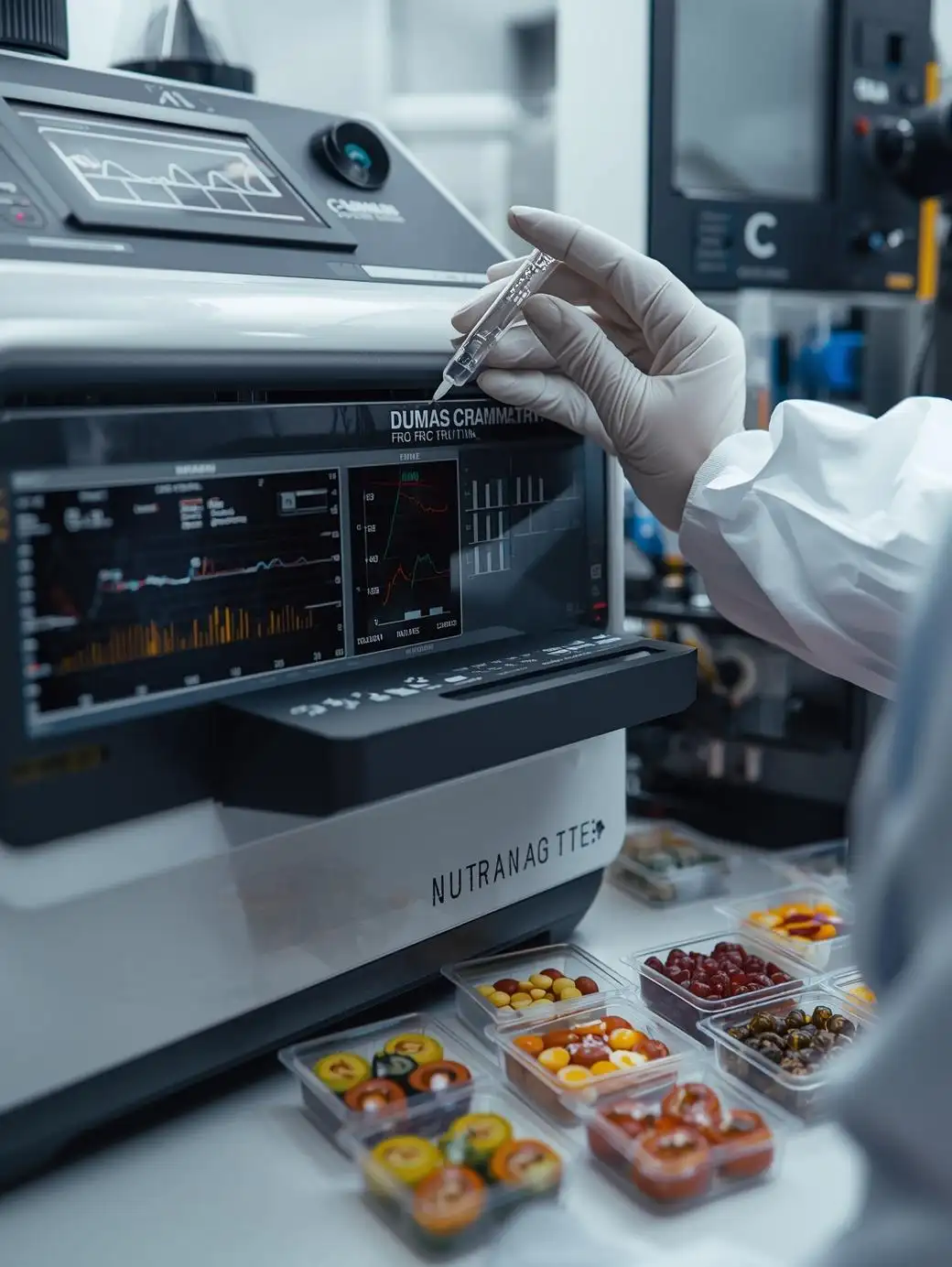
Beyond minerals, cholesterol, and caffeine, our PJLA ISO/IEC 17025:2017 scope covers the macronutrients and vitamins needed to complete an FDA Nutrition Facts panel. Every analyte below is reported under an accredited method.
Protein — AOAC 2001.11 (SOP 068, Titrimetric); Total Fat — AOAC 922.06 / USDA-FSIS CLG FAT.03 (SOP 069, Gravimetric); Saturated & Trans Fat — fatty-acid profile AOAC 996.06 (SOP 079, GC-FID); Total Dietary Fiber — AOAC 985.29 (SOP 071, Enzymatic-Gravimetric); Total Sugars — SOP 058 (HPLC), reporting glucose, fructose, galactose, sucrose, maltose and lactose; Moisture — AOAC 925.10 / 952.08 (SOP 062, Gravimetric); Ash — AOAC 920.153 / 923.03 (SOP 066, Gravimetric); Salt — USDA-FSIS CLG-SLT.04 (SOP 061, Titrimetric); Titratable Acidity — SOP 064; Vitamin A — AOAC 992.06 (SOP 082, HPLC); Vitamin C — AOAC 2012.22 (SOP 084, HPLC); Vitamin D — AOAC 2016.05 (SOP 083, HPLC).
Calories (Atwater) and Total Carbohydrate (by difference) are derived from the measured analytes above per FDA 21 CFR 101.9 convention rather than tested directly. Added Sugars cannot be measured analytically — no laboratory method distinguishes added from naturally occurring sugars — so that value is documented from your formulation and ingredient records.
PJLA ISO/IEC 17025:2017 (Cert L26-535) | 5–7 Business Days
Full Nutrition Facts panel generation, "High Protein" / "Good Source of Fiber" / "Low Fat" claim substantiation, and vitamin fortification verification.
Industries We Serve
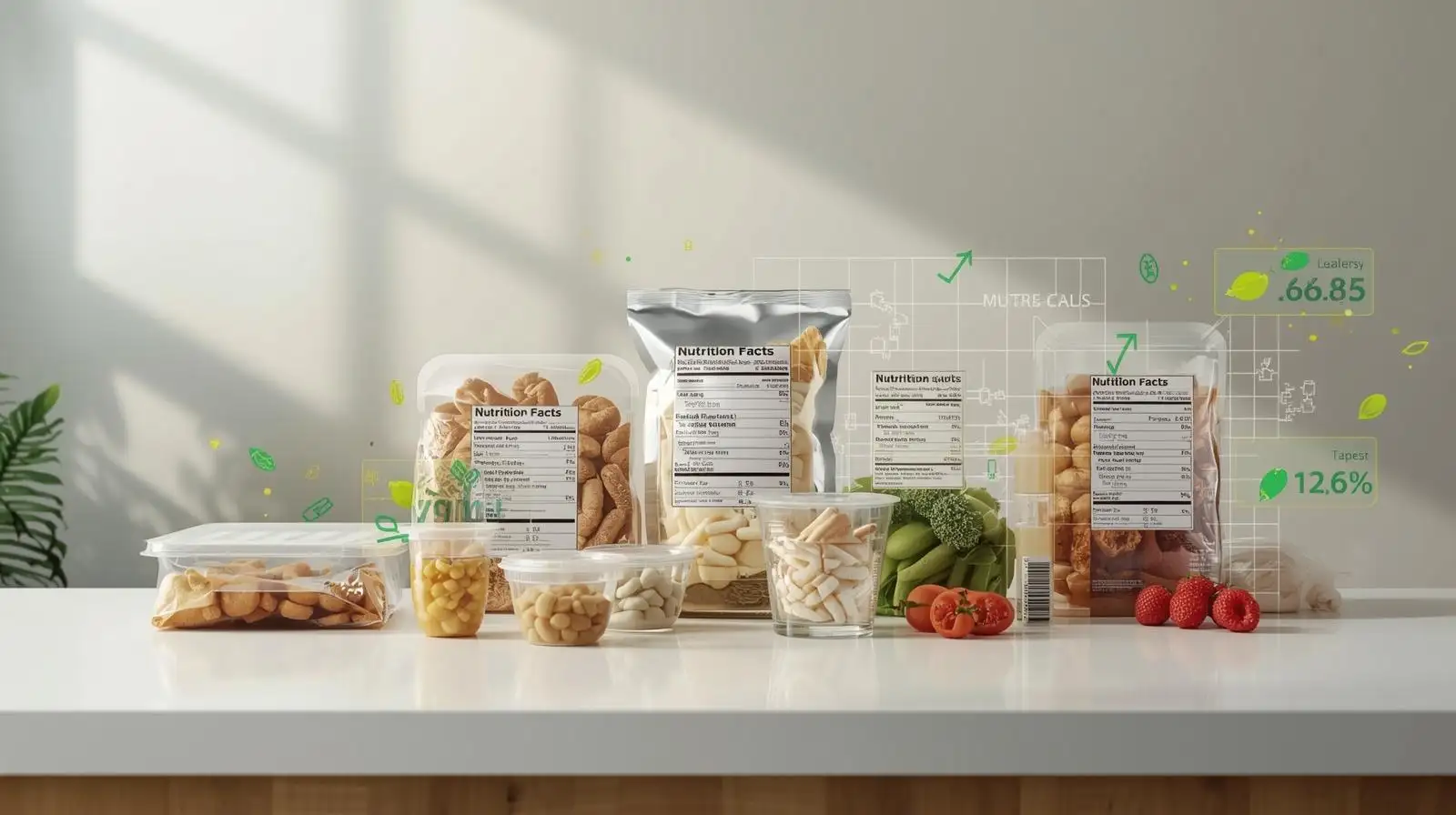
Nutritional analysis and food labeling across every food sector.

Technical Capability
Accredited platforms purpose-built for label-grade nutrient data.
-
ICP-MS — Minerals (AOAC 985.01 / 993.14, SOP 047)
Inductively Coupled Plasma Mass Spectrometry detects thirteen elements in a single run at parts-per-billion sensitivity — well below the levels required for FDA Nutrition Facts label declarations.
-
GC-FID — Cholesterol & Fatty Acids (AOAC 994.10 / 996.06)
Gas Chromatography with Flame Ionization Detection measures cholesterol directly under SOP 080 and resolves the full fatty-acid profile under SOP 079, so saturated fat, trans fat, and cholesterol are each reported from accredited determinations.
-
HPLC — Caffeine, Sugars & Vitamins
High Performance Liquid Chromatography quantifies caffeine under AOAC 979.08 / ISO 20481 (SOP 048), total sugars under SOP 058, and Vitamins A, C, and D under AOAC 992.06 / 2012.22 / 2016.05.
-
Quality Control by Method Standards
Every batch runs with a method blank, fortified spike recovery, and certified reference material, confirming accuracy under PJLA ISO/IEC 17025:2017 accreditation.
Partner with AGT Labs
From formulation to shelf, we deliver the accredited nutrient data your nutritional analysis and food labeling program needs.
ISO/IEC 17025:2017 Accredited
Nutrient analysis runs under PJLA ISO/IEC 17025:2017 (#117946, Cert L26-535) using AOAC methods for minerals, cholesterol, caffeine, protein, fat, fiber, sugars, and vitamins.
Regulatory Expertise
We help interpret nutrient results in the context of FDA NLEA labeling rules and the 21 CFR 101.9 nutrient declaration tolerances.
Formulation Support
We identify nutrient gaps or excesses to refine your recipe — particularly useful for sodium reduction, cholesterol reduction, and protein or fiber enrichment.
Common Questions About Nutritional Analysis and Food Labeling
How is cholesterol measured, and can it support a "Low Cholesterol" claim?
Do you test caffeine, and is it required on the label?
What elements are included in the ICP-MS mineral panel?
Is my Nutrition Facts data defensible if the label is challenged?
What sample size do I need to send for nutrition testing?
Need Accredited Nutritional Analysis and Food Labeling?
Send us your product and test list. We'll confirm methods, sample quantity, and turnaround before you ship.
Request a Nutrition Panel Quote