
00 · Introduction
If your food, beverage, or supplement product is sold into California, understanding the Prop 65 safe harbor levels for food is not optional. In fact, during 2025 alone, plaintiff groups filed thousands of 60-day Notices of Violation against consumer brands — and notably, trace heavy metals like lead, cadmium, and arsenic were the single largest trigger.
However, this guide breaks down the exact daily exposure limits, explains how to calculate per-serving exposure, and shows why ICP-MS testing at parts-per-billion sensitivity is the only reliable method for verifying compliance.
01 · What Is California Proposition 65?
Proposition 65 — formally the Safe Drinking Water and Toxic Enforcement Act of 1986 — requires any business selling products in California to provide a "clear and reasonable warning" before exposing consumers to chemicals known to cause cancer or reproductive harm.
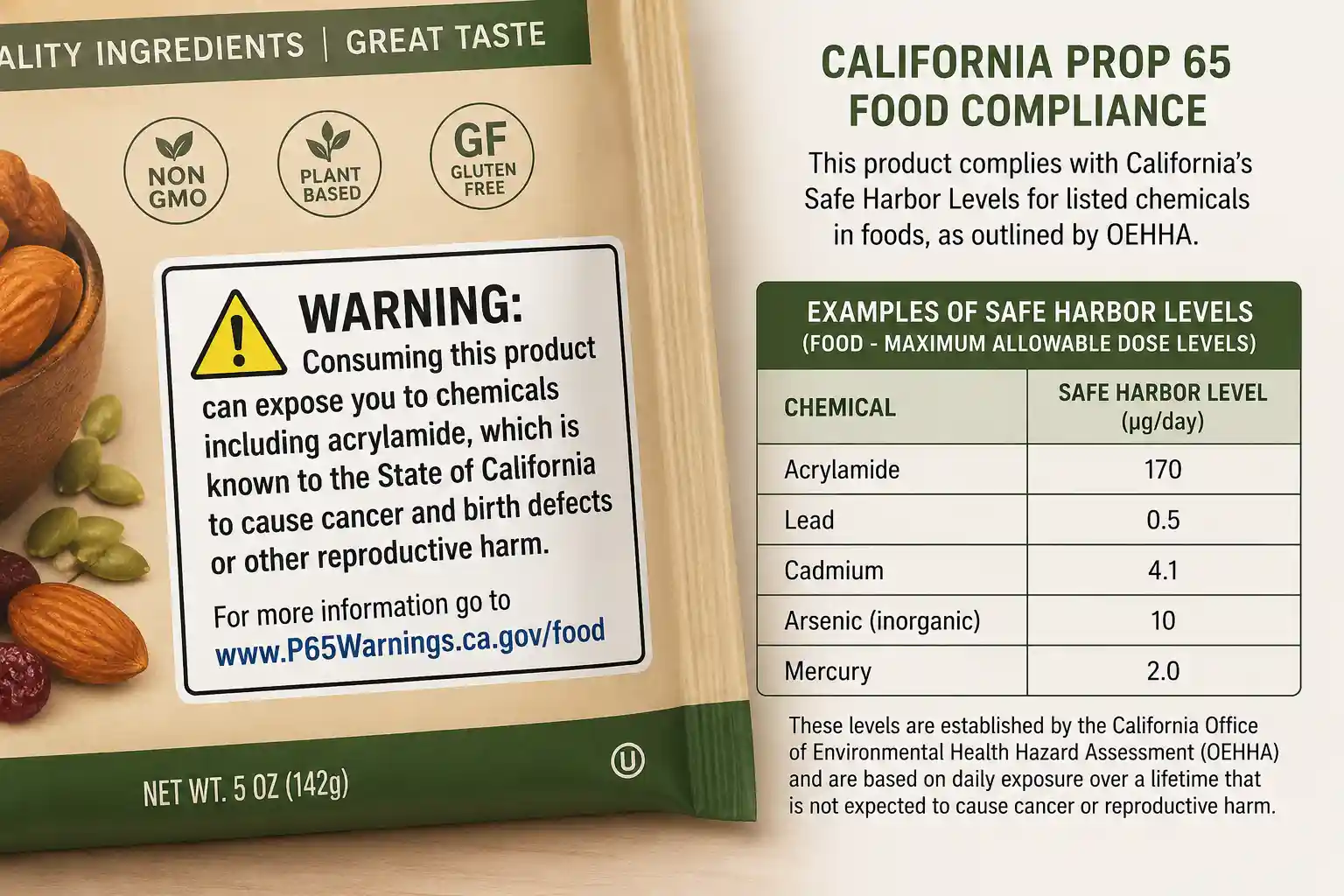
Furthermore, the California Office of Environmental Health Hazard Assessment (OEHHA) maintains the chemical list, currently more than 900 substances. For each one, OEHHA may establish a "safe harbor" — a daily exposure threshold below which no warning is required. Specifically, these are the Prop 65 safe harbor levels for food that brands must measure against:
- No Significant Risk Level (NSRL) — for carcinogens. Set at the level causing no more than 1 excess cancer in 100,000 people over 70 years.
- Maximum Allowable Dose Level (MADL) — for reproductive toxins. Set at 1/1,000th of the no-observable-effect level.
Therefore, if your product exposure stays at or below these thresholds, no warning is required. However, cross the threshold, and you must either add a Prop 65 warning label or reformulate.
02 · Why Food & Beverage Brands Are Prime Targets
Prop 65 is enforced through a "private right of action" — meaning citizens, advocacy groups, and law firms can sue on behalf of California and collect penalties plus attorneys' fees. Consequently, civil penalties reach $2,500 per violation, per day, and settlements regularly exceed $100,000.
For example, recent enforcement data shows:
- More than 5,000 60-day Notices of Violation were filed in 2025 against consumer brands.
- Notably, heavy metals — lead and cadmium — were the single largest category of violations in food, supplements, and seafood.
- Targeted products included canned beans, dried mango, herbal powders, protein powders, smoked seafood, and crystallized ginger.
Critically, even imported products, private-label SKUs, and online listings are fair game. In other words, if your brand name is on the label or you brought the product into California commerce, you are a viable defendant.
03 · The Three Heavy Metals to Test
The three metals that drive nearly all Prop 65 enforcement in food are lead, cadmium, and arsenic. Below are the exact safe harbor limits for each:
1. Lead (Pb) — The #1 Source of Notices
At just 0.5 µg/day, lead has the most punishing safe harbor of all the regulated heavy metals — roughly 1,000 times lower than FDA daily intake guidance.
Furthermore, common sources include: root vegetables, leafy greens, cacao, bone broths, herbal supplements, and spices (especially turmeric).
2. Cadmium (Cd) — Common in Plant-Based Products
Similarly, cadmium accumulates in plants, making it a challenge for organic and "clean label" brands. For instance, common sources include: cacao, sunflower seeds, leafy greens, rice, and shellfish.
3. Arsenic (As) — Speciation Matters
However, not all arsenic is equal. On the one hand, inorganic arsenic (rice, well water) is the carcinogenic form regulated by Prop 65. On the other hand, organic arsenic (seafood, seaweed) is largely harmless. Therefore, arsenic speciation testing distinguishes the two — without it, brands often add unnecessary warnings or reformulate products that were always compliant.
04 · Calculating Your Exposure
The Prop 65 exposure formula is straightforward:
0.05 ppm lead × 30g = 1.5 µg lead per serving. Versus MADL of 0.5 µg/day → Warning required.
Similarly, 0.18 ppm cadmium × 24g = 4.32 µg cadmium/day. Versus MADL of 4.1 µg/day → Warning required (just barely).
Therefore, a "passing" FDA result tells you nothing about Prop 65 status. Specifically, you need lab detection limits below 0.01 ppm (10 ppb) to confidently certify a product against these safe harbor limits — meaning ICP-OES is not enough.
05 · Why ICP-MS Is the Only Acceptable Method
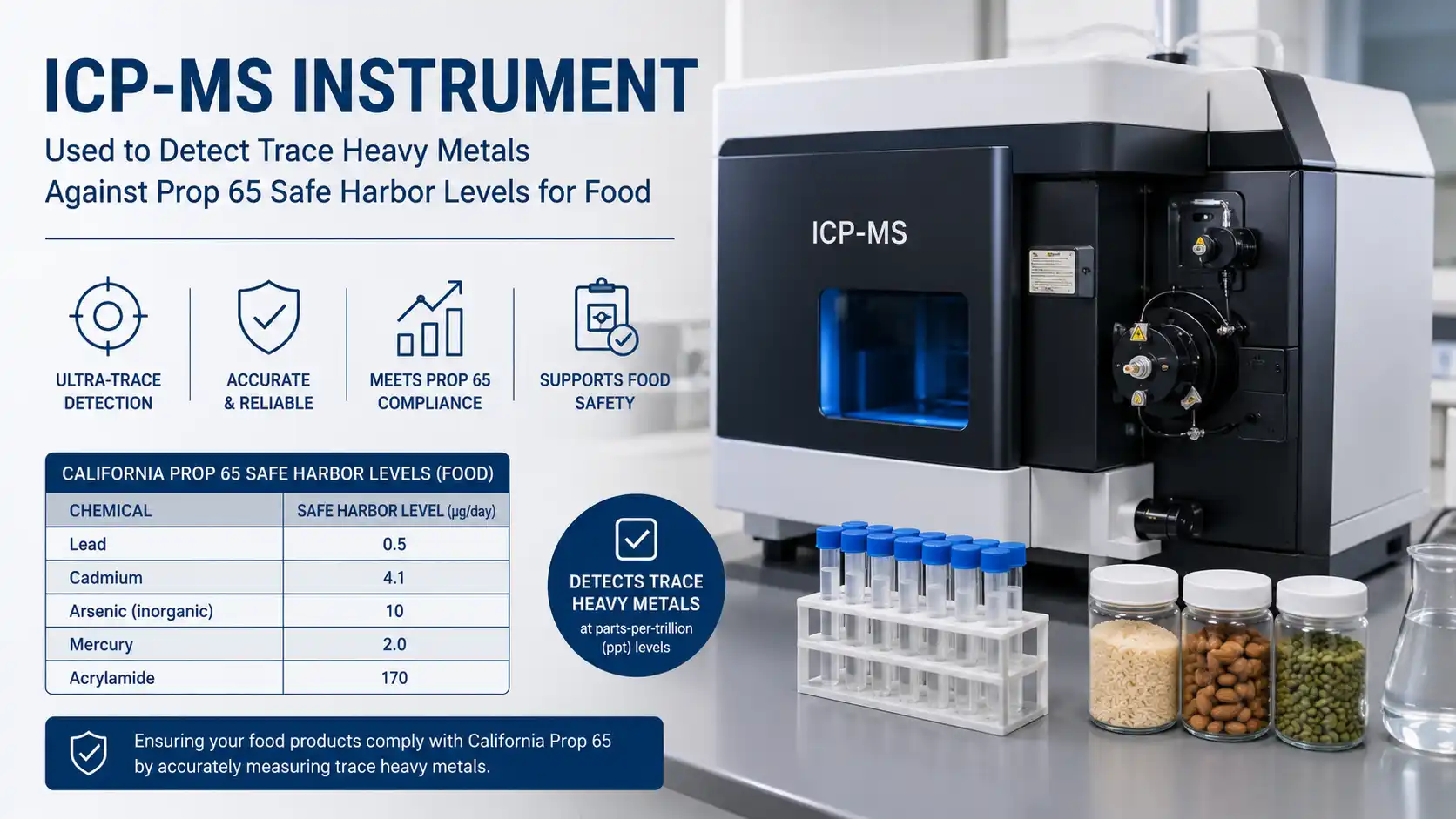
Standard labs often default to ICP-OES, which has detection limits in the parts-per-million range. However, for Prop 65, that's a liability — it produces false-pass results because the OEHHA safe harbor thresholds sit far below ICP-OES detection limits.
| Method | Detection Limit | Adequate? |
|---|---|---|
| ICP-OES | ~0.1–1 ppm | No — false passes |
| ICP-MS | 0.001–0.01 ppm | Yes |
| ICP-MS + Speciation | Sub-ppb | Required for arsenic |
In contrast, at AGT Labs food testing, every Prop 65 panel uses ICP-MS following AOAC 2015.01 — the gold standard validated for lead, cadmium, arsenic, and mercury in foods.
06 · If You Receive a 60-Day Notice
A 60-day Notice of Violation is the formal first step in Prop 65 enforcement. Once served, you have 60 days to respond. Generally, the common outcomes are:
- Negotiated settlement — typically $25,000 to $250,000+, plus reformulation or labeling, plus attorneys' fees.
- Reformulation agreement — commit to reducing the chemical below safe harbor levels in a defined window.
- Warning label addition — add a compliant Prop 65 warning and pay penalties.
- Defense on the merits — viable only with defensible lab data dated before the alleged violation.
Indeed, the single best defense is documented, accredited testing performed before the notice arrives. In other words, a CoA from an ISO 17025–accredited lab, dated prior to the alleged violation, is your strongest evidence of good-faith compliance with OEHHA's safe harbor thresholds.
07 · A Prop 65 Testing Strategy
Below is the testing program we recommend for any brand selling into California:
Before launch, test for the "Big 4" — lead, cadmium, arsenic, mercury — using ICP-MS. Then convert results into µg/day exposure based on labeled serving size, and finally compare against the safe harbor limits.
If your product contains rice, rice syrup, seaweed, or seafood, also request inorganic arsenic speciation in addition to total arsenic.
Generally, heavy metal content varies by season, soil, and supplier. Therefore, test new ingredient lots or run quarterly verification on finished goods.
Finally, keep dated, accredited CoAs for every lot. Because if a 60-day notice arrives, this file is the difference between a six-figure settlement and a defensible position.